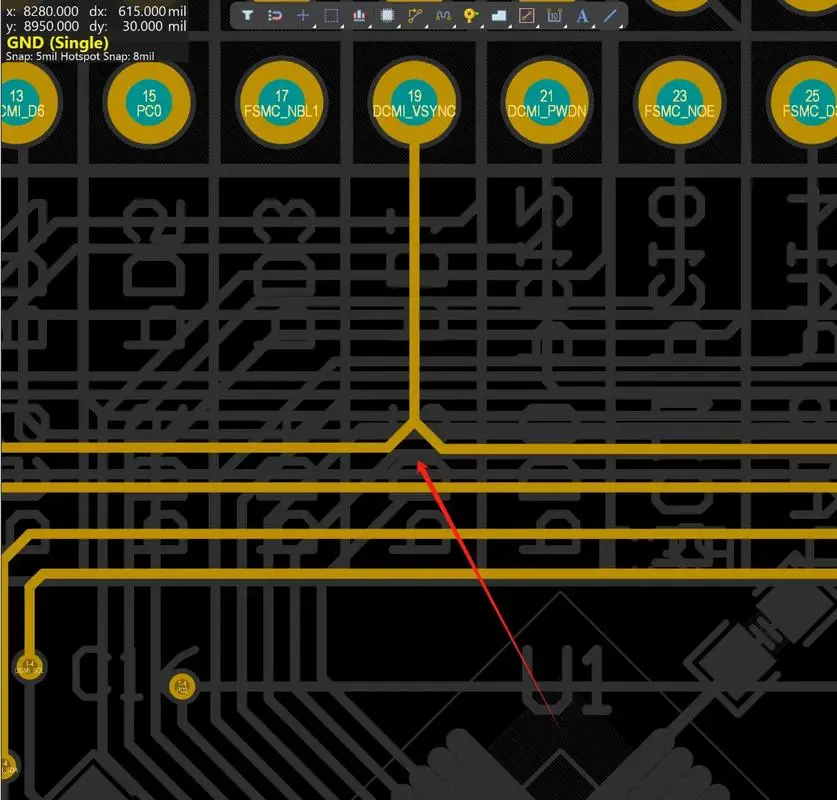
1. Introduction: The Significance of Trace Corner Design PCB trace corners are transitional structures where conductors change direction. Despite the seemingly minor angle difference (45-degree vs. right angle), they directly impact a PCB’s electrical peRFormance, manufacturing precision, and long-term reliability. While standard PCBs (e.g., for consumer electronics or industrial control) do not require military-grade design rigor, "prioritizing 45-degree corners" has become an industry default. The core logic is that 45-degree corners, with their smooth transition, avoid the various risks of right angles, balancing performance, manufacturability, and cost.
Signal integrity is a key requirement for PCB routing, especially when signal frequencies exceed 100MHz (e.g., USB 3.0, Ethernet signals). The angle of corners significantly affects signal transmission, rooted in the principle of "impedance continuity": According to transmission line theory, a PCB trace’s characteristic impedance (Z₀) depends on trace width, copper thickness, and dielectric constant (formula: Z₀ ≈ (60/√εᵣ) × ln(4h/w), where h = dielectric thickness, w = trace width).
- At right-angle corners, the actual trace width experiences a "discontinuity": the effective width of the outer side (w₁) becomes wider than the designed value (due to increased copper exposure), while the inner side (w₂) narrows (reduced copper exposure);
- This uneven width causes impedance fluctuations at the corner (e.g., designed for 50Ω, but right-angle corners may drop to 40Ω or rise to 60Ω), disrupting impedance matching. When high-frequency signals pass through right angles, signal reflection occurs due to impedance 突变 (reflection coefficient Γ = (Z₂-Z₁)/(Z₂+Z₁), where Z₁ = incident impedance, Z₂ = corner impedance). Reflected signals overlap with incident signals, causing waveform distortions like "overshoot" or "ringing" (Figure 1), which can lead to data transmission errors (e.g., increased bit error rates).
45-degree corners feature a smooth transition, with trace width variation only 1/3 to 1/2 that of right angles (Figure 2):
- Impedance fluctuation at 45-degree corners is controlled within ±5% (meeting impedance matching requirements for high-frequency signals), with a reflection coefficient Γ < 0.05. Reflected signal amplitude is extremely low, and waveform distortion is negligible;
- Even for mid-frequency signals (50–100MHz), 45-degree corners avoid signal delay (right angles may introduce 10–20ps of additional delay due to impedance discontinuity), ensuring timing synchronization (e.g., clock and data signals in SPI buses).
Conclusion: For high/mid-frequency signal routing, 45-degree corners reduce defect rates caused by signal reflection by over 70%, while right angles can shorten high-frequency signal transmission distances by 30% (due to increased reflection loss).
The "etching process" (removing excess copper with chemical solutions) in PCB manufacturing is highly sensitive to corner angles. Right-angle corners easily cause trace width deviations, impairing electrical performance:
During etching, trace width precision depends on the contact area between copper and etchant, as well as reaction rate:
- The outer side (convex surface) of right-angle corners has a larger exposed copper area, leading to more aggressive etchant attack ("over-etching"). This reduces the actual trace width below the design value (e.g., designed for 0.2mm, etched to only 0.17mm);
- The inner side (concave surface) of right-angle corners forms an "etching shadow zone," where etchant cannot fully penetrate, causing "under-etching" and residual copper (forming "copper nodules"). This risks short circuits between adjacent traces, especially in high-density routing with spacing ≤ 0.1mm.
45-degree corners have a gradual transition with no sharp convex/concave surfaces:
- Etchant distributes evenly at 45-degree corners, limiting trace width deviation to ±0.02mm (meeting IPC-6012 standards for standard PCB trace precision);
- No additional etching compensation is needed (right angles require 0.03mm width compensation during design, increasing complexity), reducing manufacturing difficulty and cost.
Example: A consumer electronics PCB with 0.2mm trace width and 0.2mm spacing showed 15% of traces had width deviations >0.04mm after right-angle etching, while 45-degree corners had a deviation rate of only 2%, reducing short-circuit risk by 90%.
The "sharp edge" of right-angle corners disrupts electric field distribution, causing electromagnetic interference (EMI), while 45-degree corners significantly improve EMC performance:
Based on electromagnetism, "sharp edges" cause electric field concentration (similar to the tip discharge effect of lightning rods):
- Electric field intensity at right-angle tips is 3–5 times higher than that of smooth traces. When high-frequency signals pass through, the tip acts as a "miniature antenna," radiating electromagnetic energy (stronger at higher frequencies) and generating EMI. This interferes with nearby sensitive components (e.g., RF modules, sensors);
- Sharp edges also easily absorb external electromagnetic interference (e.g., power supply noise), reducing signal signal-to-noise ratio (SNR) (e.g., noise in analog audio signals).
45-degree corners have no sharp edges, ensuring uniform electric field distribution:
- Electromagnetic radiation intensity is only 1/10–1/5 that of right angles (measured with EMC test equipment: at 1GHz, 45-degree corners radiate ≤30dBμV/m, while right angles reach 50dBμV/m), complying with EMC standards like CE and FCC;
- Anti-interference capability is 40% stronger, minimizing the impact of external interference on signals—critical for scenarios like medical electronics or automotive electronics with strict EMC requirements.
PCBs may endure bending or vibration during use (e.g., phone drops, industrial equipment vibration). Right-angle corners concentrate stress, leading to copper fatigue and fracture:
Copper and PCB substrates (FR4) have different thermal expansion coefficients (copper: 16.5ppm/℃, FR4: 13ppm/℃). Temperature changes or mechanical bending cause differential deformation, generating stress:
- Stress at right-angle corners cannot disperse effectively and concentrates at the tip (stress value is 2–3 times that of smooth traces);
- Over time, microcracks form at the tip, gradually expanding into open circuits (e.g., after 1,000 bending tests on an industrial PCB, 25% of right-angle traces fractured, compared to only 3% of 45-degree traces).
45-degree corners have a longer transition length (≈41% longer than right angles for the same direction change), allowing stress to disperse evenly along the corner:
- Maximum stress on copper is reduced by over 60%, significantly improving fatigue resistance and extending PCB service life by 30%–50%;
- For flexible PCBs (FPCs), 45-degree corners are even more critical—FPCs require frequent bending, making right angles practically unusable, while 45-degree corners withstand 100,000 bending cycles without fracture.
Right-angle corners are not entirely prohibited; they may be used sparingly in low-demand scenarios:
- Low-Frequency, Low-Precision Circuits: Signals with frequencies <50MHz (e.g., power loops, low-frequency sensor signals) and trace widths ≥0.3mm—right angles have negligible performance impact;
- Extremely Limited Routing Space: Local areas of high-density PCBs (e.g., under IC pins) where 45-degree routing is impossible. Right angles may be used, but trace width compensation (0.03mm wider than required) is needed, and they must be kept away from sensitive components;
- Single-Layer or Simple PCBs: PCBs for toys or basic chargers with no high-frequency or reliability requirements—right-angle routing simplifies design.
Note: Even in these cases, right-angle corners should account for ≤10% of total traces, and consecutive right angles (e.g., "Z-shaped" right-angle routing) should be avoided to prevent risk accumulation.
Prioritizing 45-degree corners for standard PCBs essentially means "trading a small increase in trace length for comprehensive optimization of performance, manufacturability, and reliability." Their core advantages are summarized below:
Design Recommendations:
- Use "auto 45-degree corner" functions in PCB design software (e.g., Altium Designer, Cadence) and disable right-angle routing;
- High-frequency signals (>100MHz) and sensitive signals (e.g., analog audio, sensor signals) must use 45-degree corners, with a corner radius ≥ trace width;
- During routing checks, use Design Rule Check (DRC) tools to identify right-angle corners and ensure compliance with design specifications.
In short, 45-degree corners are the "optimal solution" for standard PCB routing—they significantly improve product performance and reliability without additional cost, making them one of the "highest-cost-effectiveness" detail optimizations in PCB design.

 PCB
PCB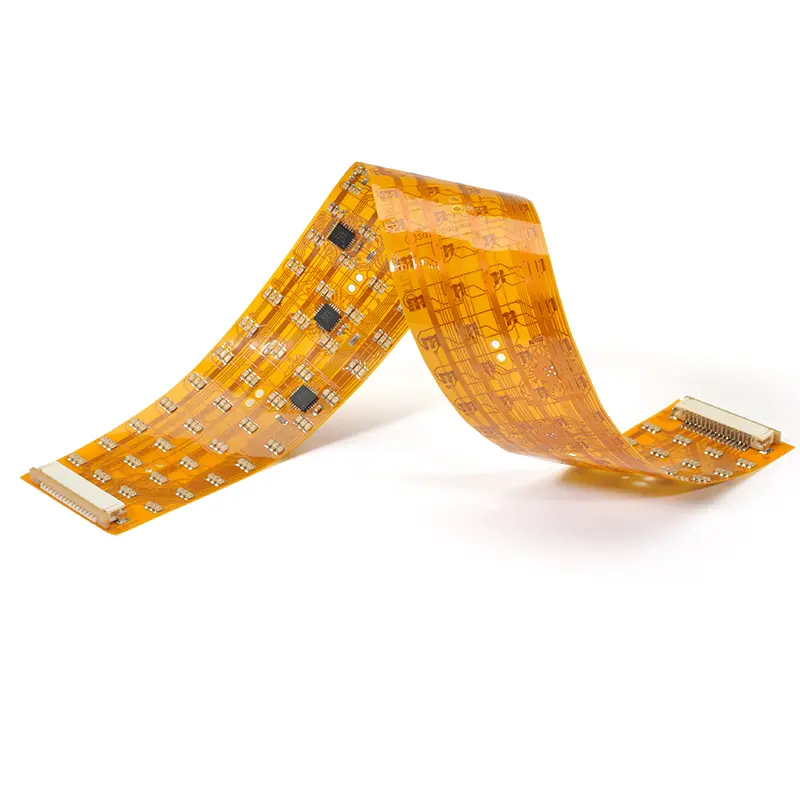 FPC
FPC Rigid-Flex
 FR-4
FR-4 HDI PCB
 Rogers High-Frequency Board
 PTFE Teflon High-Frequency Board
 Aluminum
 Copper Core
 PCB Assembly
 LED light PCBA
 Memory PCBA
 Power Supply PCBA
 New Energey PCBA
 Communication PCBA
 Industrial Control PCBA
 Medical Equipment PCBA
 Testing Service
 PCBA Testing Service
 Certification Application
 RoHS Certification Application
 REACH Certification Application
 CE Certification Application
 FCC Certification Application
 CQC Certification Application
 UL Certification Application
 Transformers, Inductors
 High Frequency Transformers
 Low Frequency Transformers
 High Power Transformers
 Conversion Transformers
 Sealed Transformers
 Ring Transformers
 Inductors
 Wires,Cables Customized
 Network Cables
 Power Cords
 Antenna Cables
 Coaxial Cables
 Net Position Indicator
 Solar AIS net position indicator
 Capacitors
 Connectors
 Diodes
 Embedded Processors & Controllers
 Digital Signal Processors (DSP/DSC)
 Microcontrollers (MCU/MPU/SOC)
 Programmable Logic Device(CPLD/FPGA)
 Communication Modules/IoT
 Resistors
 Through Hole Resistors
 Resistor Networks, Arrays
 Potentiometers,Variable Resistors
 Aluminum Case,Porcelain Tube Resistance
 Current Sense Resistors,Shunt Resistors
 Switches
 Transistors
 Power Modules
 Isolated Power Modules
 AC-DC Power Modules
 DC-AC Module(Inverter)
 RF and Wireless