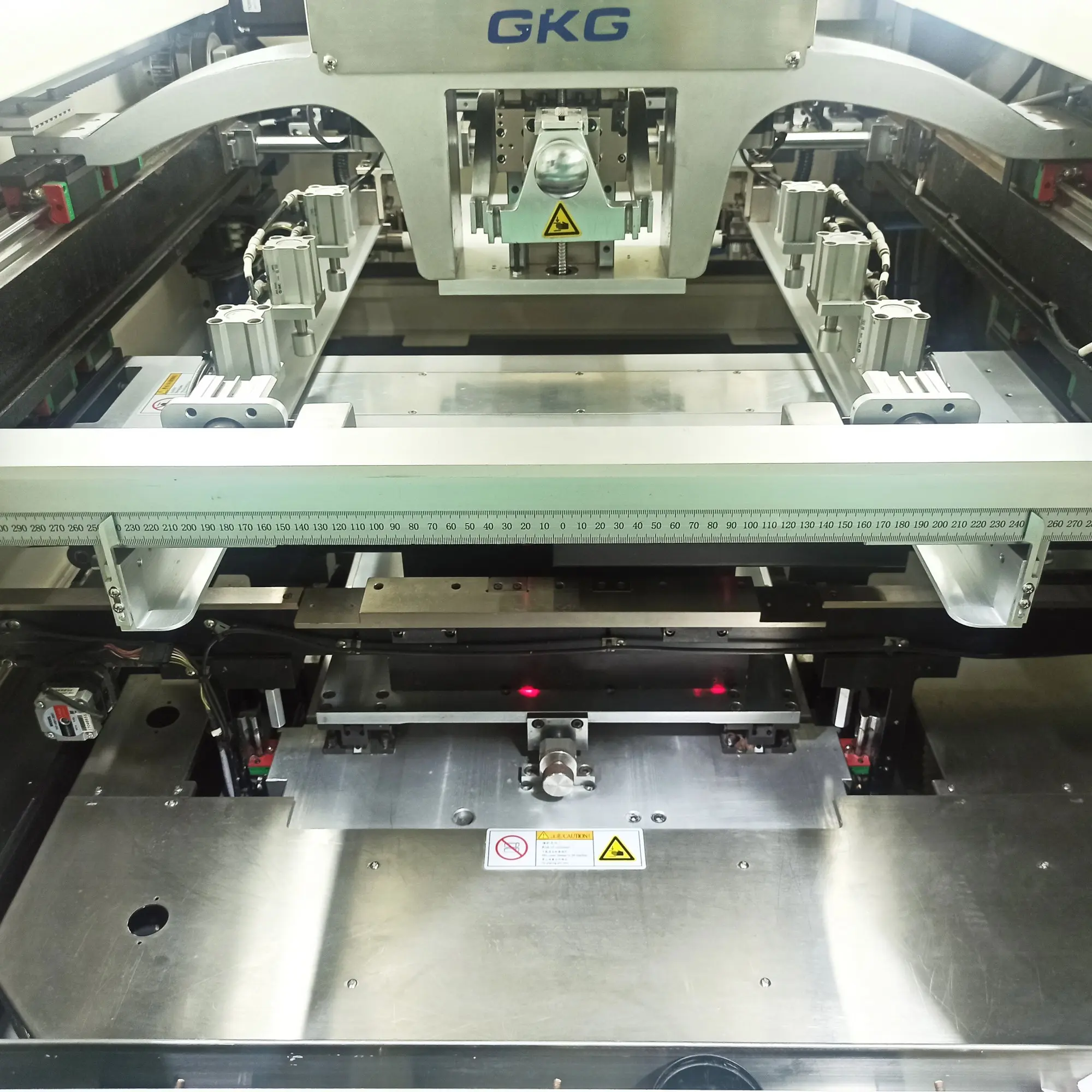
1. Introduction: Core Relationship Between Solder Paste Volume and Stencil Thickness In SMT (SuRFace Mount Technology) production, the soldering quality of chip components such as 0603 (0.6mm×0.3mm) and 0805 (0.8mm×0.5mm) essentially depends on the **precise control of solder paste volume**: excessive solder paste easily causes component pin bridging (short circuits), while insufficient paste leads to cold solder joints (solder failing to fully wrap pins). As the core tool for solder paste printing, the stencil (also known as the screen printing stencil) directly determines the "solder paste volume on each component pad"—designing stencil thickness (e.g., 0.12-0.15mm) to match component package sizes is the most critical method for standardizing solder paste volume. Industry statistics show that **approximately 80% of SMT solder paste volume deviations result from improper stencil thickness selection**.
Solder paste volume control follows the logic of "volume conservation": during printing, solder paste fills PCB pads through stencil apertures, and the final volume of solder paste transferred to the pads (V) ≈ stencil aperture area (A) × stencil thickness (T) (excluding minor losses caused by solder paste viscosity). Among these, stencil thickness (T) is the only core variable that can be directly quantified and adjusted; the aperture area must match the component pad size, and both jointly determine whether the solder paste volume meets component requirements.
It should be clarified: Components with different packages (0603 vs. 0805) require different solder paste volumes due to variations in pad size and pin pitch. Therefore, differentiated stencil thicknesses must be used for precise matching—there is no "universal thickness," and customization based on component type is necessary.
As the most commonly used SMT chip components (primarily Resistors and capacitors), 0603 and 0805 require stencil thickness selection based on pad size and soldering risks (bridging/cold joints). The industry has established standardized ranges:
- Basic Component and Pad Parameters:
The standard pad size for 0603 components is "length 0.4-0.5mm × width 0.25-0.3mm," with a pad pitch of approximately 0.2mm (distance between adjacent pad edges). Due to the small pitch, excessive solder paste easily causes bridging. - Stencil Thickness Selection Logic:
- Recommended thickness: 0.12-0.13mm (0.12mm preferred), corresponding to a solder paste volume of approximately 0.012-0.016mm³ (calculated with aperture area = 80% of pad area, i.e., 0.45mm×0.28mm×0.8 = 0.1008mm², multiplied by 0.12mm thickness to get 0.012mm³);
- Why not thicker (e.g., 0.14mm): Increasing thickness to 0.14mm raises the solder paste volume to over 0.014mm³. After printing, the paste easily forms a "solder bridge" between adjacent pads, and molten solder directly connects pins during soldering, increasing bridging defect rates from ≤1% to over 5%;
- Why not thinner (e.g., 0.11mm): Excessively thin stencils result in insufficient solder paste (<0.011mm³). During soldering, solder cannot fully cover the bottom of component pins, significantly increasing cold solder joint rates (from ≤0.5% to 3%).
- Basic Component and Pad Parameters:
The standard pad size for 0805 components is "length 0.5-0.6mm × width 0.3-0.35mm," with a pad pitch of approximately 0.25mm (25% wider than 0603). This provides higher tolerance for solder paste volume, and the slightly larger component size requires more solder to ensure mechanical strength. - Stencil Thickness Selection Logic:
- Recommended thickness: 0.13-0.15mm (0.13-0.14mm for general scenarios; 0.15mm for high-power 0805 components such as 2W resistors), corresponding to a solder paste volume of approximately 0.018-0.025mm³ (calculated with aperture area = 85% of pad area, i.e., 0.55mm×0.32mm×0.85 = 0.1496mm², multiplied by 0.13mm thickness to get 0.019mm³);
- Advantages of thickness adaptation: A 0.13mm thickness balances "solder coverage" and "bridging risk"—the paste volume is sufficient to wrap 0805 component pins (pin width ~0.2mm), and the larger pitch controls bridging defect rates to ≤0.8%;
- Special adjustment for high-power scenarios: 0805 power resistors above 2W require larger pads (length 0.6-0.7mm) for heat dissipation. Thickness should be increased to 0.15mm to ensure sufficient solder paste (>0.022mm³) and improve solder joint heat dissipation (preventing solder overheating and aging).
Determining stencil thickness alone is insufficient for complete solder paste volume control. A comprehensive control system of "thickness + supporting measures" is required, incorporating stencil aperture design, solder paste properties, and printing parameters to avoid deviations from over-reliance on thickness:
Stencil apertures represent the "second dimension" of solder paste volume and must be designed synchronously with thickness:
- Aperture area ratio: For general 0603/0805 components, stencil aperture area should be 75%-85% of the PCB pad area (75%-80% for 0603, 80%-85% for 0805). If apertures are too large (e.g., equal to pad area), solder paste volume will exceed standards (increasing bridging risk) even with compliant thickness; if apertures are too small (e.g., <70%), the effect of thick stencils will be negated (insufficient paste);
- Aperture shape: Rectangular apertures (matching pad shape) are preferred over circular or irregular shapes—circular apertures reduce effective filling area (15%-20% less than rectangular ones), causing solder paste volume deviations.
Solder paste particle size (powder diameter) and viscosity must match stencil thickness, otherwise solder paste transfer efficiency (actual paste volume transferred to pads/theoretical volume) will be affected:
- Particle size selection: 0.12-0.15mm stencils require "Type 3" solder paste (powder diameter 25-45μm). Using coarser Type 2 paste (45-75μm) easily clogs stencil apertures (especially 0.12mm thin stencils), leading to insufficient solder paste;
- Viscosity requirement: Viscosity should be controlled at 100-150Pa·s (25℃). Excessively high viscosity (>180Pa·s) prevents full aperture filling (transfer efficiency <80%), while excessively low viscosity (<80Pa·s) causes "solder paste slump" (paste spreads after printing, effectively increasing volume and triggering bridging).
Printing pressure and speed affect the adequacy of solder paste aperture filling and must be adjusted to match stencil thickness:
- Printing pressure: 5-8N for 0.12-0.13mm stencils, 8-12N for 0.14-0.15mm stencils. Insufficient pressure (<5N) leads to incomplete filling (low transfer efficiency), while excessive pressure (>15N) squeezes paste, resulting in actual thickness thinner than designed (e.g., 0.13mm stencil printing at 0.11mm);
- Printing speed: Uniformly controlled at 20-30mm/s. Excessively fast speed (>40mm/s) prevents timely aperture filling, while excessively slow speed (<15mm/s) increases friction between paste and stencil, causing paste adhesion to aperture edges (affecting subsequent printing).
After determining stencil thickness, a closed loop of "printing inspection → soldering verification → thickness fine-tuning" is required to ensure solder paste volume meets requirements:
A 3D Solder Paste Inspection (SPI) machine is used to measure the solder paste volume and height on each component pad:
- Qualification criteria: For 0603 components, solder paste volume deviation ≤±15% (designed 0.012mm³, measured 0.0102-0.0138mm³) and height deviation ≤±10% (designed 0.12mm, measured 0.108-0.132mm); the same applies to 0805 components;
- Abnormal handling: If volume is generally low (e.g., 0603 measured <0.0102mm³), check if the stencil is too thin or apertures are clogged; if volume is high (e.g., 0805 measured >0.02875mm³), check if the stencil is too thick or apertures are oversized.
An Automated Optical Inspection (AOI) system checks for bridging and cold solder joint defects after soldering:
- If bridging rate >1%: Prioritize reducing stencil thickness (e.g., 0805 from 0.15mm to 0.14mm) or reducing aperture area (from 85% to 80%);
- If cold solder joint rate >0.5%: Prioritize increasing stencil thickness (e.g., 0603 from 0.12mm to 0.13mm) or expanding aperture area (from 80% to 85%), while checking if solder paste viscosity is too high.
- Frequency: For every 5,000 PCBs produced, sample 10 boards and recheck solder paste volume with SPI to ensure no stencil wear (thickness reduction) or deformation (local thickening);
- Stencil lifespan: The normal service life of stainless steel stencils is 50,000-80,000 prints. Beyond this, thickness may decrease by 0.01-0.02mm due to wear, requiring timely replacement or re-manufacturing.
- Consequence: Ignoring component power differences (e.g., 0805 general resistor vs. 2W power resistor) leads to insufficient solder paste for high-power components (poor heat dissipation);
- Mitigation: Classify components as "general-purpose/high-power": use 0.13mm for high-power 0603 (1W) and 0.15mm for high-power 0805 (2W); follow basic thickness for general components.
- Consequence: Using a 0.12mm stencil for 0603 (compliant) but with aperture area equal to pad area (no reduction) still results in excessive solder paste volume;
- Mitigation: Clearly specify "aperture area = 75%-85% of pad area" when manufacturing stencils, and mark this on stencil drawings to prevent manufacturer errors.
- Consequence: Using a 0.15mm stencil for 0603 causes excessive solder paste volume, increasing bridging rates to over 10% and raising rework costs;
- Mitigation: Strictly follow industry-standard thicknesses, aiming for "no bridging, no cold joints" rather than pursuing "more solder."
Solder paste volume control for SMT components (0603, 0805) essentially involves "precise matching of stencil thickness to component packages." The core principles can be summarized as:
- Determine basic thickness by package: 0603 → 0.12-0.13mm, 0805 → 0.13-0.15mm; appropriately increase thickness for power components;
- Supplement with aperture synergy: Design aperture area = 75%-85% of pad area, synchronously with thickness;
- Adjust deviations based on inspection: Reduce thickness/shrink apertures for bridging; increase thickness/expand apertures for cold joints;
- Maintain stability by lifespan: Regularly monitor stencil wear and replace promptly to avoid thickness drift.
This standardized method can increase the soldering yield of 0603/0805 components to over 99.5% and control solder paste volume deviation within ±10%, making it a "low-cost, high-reliability" solder paste control solution for SMT mass production.

 PCB
PCB FPC
FPC Rigid-Flex
 FR-4
FR-4 HDI PCB
 Rogers High-Frequency Board
 PTFE Teflon High-Frequency Board
 Aluminum
 Copper Core
 PCB Assembly
 LED light PCBA
 Memory PCBA
 Power Supply PCBA
 New Energey PCBA
 Communication PCBA
 Industrial Control PCBA
 Medical Equipment PCBA
 Testing Service
 PCBA Testing Service
 Certification Application
 RoHS Certification Application
 REACH Certification Application
 CE Certification Application
 FCC Certification Application
 CQC Certification Application
 UL Certification Application
 Transformers, Inductors
 High Frequency Transformers
 Low Frequency Transformers
 High Power Transformers
 Conversion Transformers
 Sealed Transformers
 Ring Transformers
 Inductors
 Wires,Cables Customized
 Network Cables
 Power Cords
 Antenna Cables
 Coaxial Cables
 Net Position Indicator
 Solar AIS net position indicator
 Capacitors
 Connectors
 Diodes
 Embedded Processors & Controllers
 Digital Signal Processors (DSP/DSC)
 Microcontrollers (MCU/MPU/SOC)
 Programmable Logic Device(CPLD/FPGA)
 Communication Modules/IoT
 Resistors
 Through Hole Resistors
 Resistor Networks, Arrays
 Potentiometers,Variable Resistors
 Aluminum Case,Porcelain Tube Resistance
 Current Sense Resistors,Shunt Resistors
 Switches
 Transistors
 Power Modules
 Isolated Power Modules
 AC-DC Power Modules
 DC-AC Module(Inverter)
 RF and Wireless